Home → Fish & Wildlife → Wildlife → Species Information → Birds → Raptors → Golden Eagles
Golden Eagle
Aquila chrysaetos
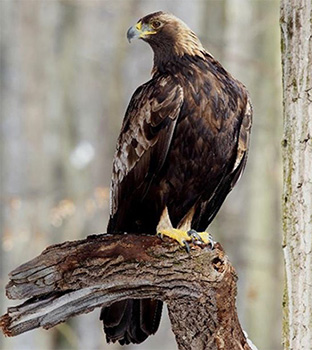
Golden eagle, photo by Randy Flament
Maine species listing status: State Endangered
The golden eagle is about the same size as a bald eagle.On this page:
- Identification
- Habitat
- Diet
- Nesting
- Distribution and Range
- Status
- Threats
- Conservation and Management
- How You Can Help
Maine Golden Eagle Study
Understanding golden eagles in Maine—one sighting at a time.
Identification
Golden and bald eagles are about the same size, standing around 2.5 feet tall with a wingspan of 6.5 feet, and weighing around ten pounds on average. Females are approximately 30% larger than males. Golden eagles have a relatively smaller head and beak compared to bald eagles. Golden eagles have feathers down to their feet, but bald eagles do not.
Juvenile golden eagles are also dark except for a broad band of white at the base of the tail feathers, distinct white patches under the wing, and have amber plumage on the back of the head and neck, as do adults. The white patches on the underside of the wing of the golden eagle begin to change to brown as a buffy wing bar develops on the top. At four to five years old, mature golden eagles have lost their white tail band and are dark with a buffy wing bar.
View Maine Eagle Identification Guide (PDF)
Habitat
Golden eagles use a variety of landscapes across Maine, with their presence shifting by season.
Migration and Wintering
During migration, golden eagles can be found throughout the state. Recent trail camera data has documented individuals in the western mountains, mid-coast, and coastal regions during both migration and winter. While they are more frequently recorded in these areas, their apparent absence elsewhere may reflect limited camera coverage rather than a lack of eagles.
Overwintering eagles utilize a range of habitat types, including:
- Mature pine forests and heavily forested areas with small openings.
- Open landscapes such as fields, barrens, and wetlands.
- Varied elevations, as they are not restricted to ridge tops or high-relief terrain.
Trail cameras have also documented individuals returning to the same locations in successive winters, suggesting potential site fidelity.
Age and Behavior
While subadult eagles tend to have more widespread movements, current data suggest their winter habitat selection is similar to that of adults.
Potential Breeding Habitat
If undetected breeding adults are present in the state, they are most likely located in northern or western Maine near the Quebec border. While these birds are often associated with remote cliffs, they are not restricted to them and may also build large stick nests in trees. Currently, the nearest known territories are in Quebec, including the Gaspé Peninsula.
Diet
Golden eagles are opportunistic predators that can capture prey as large as a turkey. They hunt from elevated perches or while flying, either close to the ground or high above, soaring to catch most prey on or near the ground.
In the western U.S., golden eagles mainly eat mammals and birds, especially rabbits and hares, ground squirrels, and medium-sized birds. Less is known about the diet in the eastern U.S. Ungulates, great blue herons, Canada geese, wild turkeys, woodchucks/groundhogs, snowshoe hares, red foxes, and other similarly sized mammals are among their prey. Besides hunting live prey, golden eagles also scavenge at all times of the year. However, scavenging is thought to be less common during the breeding season.
Nesting
Golden eagles reach breeding age at five years or older and can live more than 30 years in the wild, with even longer lifespans in captivity. Mature individuals typically arrive at breeding areas in Canada from March to April. Younger birds, including subadults (between one and five years old) and juveniles (less than one year old), usually arrive later in the season, between late April and June.
Limited historical insights into Maine's breeding phenology of golden eagles are available from the eight successful nests documented (1950s to late '90s). The earliest territorial presence was recorded on March 6. The egg-laying period ranged from March 26 to April 26. Hatching occurred between May 6 and June 6, and fledging occurred from July 15 to August 8. Shifts in phenology due to changing weather patterns may have since altered these ranges and possibly moved them earlier.
Golden eagles exhibit a courtship display called "sky-dancing. " They perform up to 20 steep dives up and down, rise, and then turn to retrace and repeat the pattern. The pair also circles high in the sky and dives at each other.
Breeding home ranges vary in size depending upon prey availability, topography, vegetation, and prior breeding success. Research from telemetry studies reports that breeding-season home ranges in eastern North America range from 14 to 5,647 square miles (up to nearly 1/6 the size of Maine!).
A breeding territory often contains more than one nest, and pairs may switch between nests during different breeding seasons. Cliffs appear to be the preferred nesting strata, but when cliffs are not available, eagles readily nest in trees, on the ground, and on platforms. In Québec, golden eagles typically nest on cliffs but have also been documented nesting in trees. In Manitoba, nests are in trees. Historical nest sites in the eastern United States were found on cliffs or trees across New England and New York.
Nests are typically 5 to 6 feet wide and up to 2 feet high. They are built using sticks, vegetation, and sometimes animal bones, with construction occurring in spring, fall, or winter. One to three eggs are laid, each weighing about 105 grams, approximately the weight of a deck of cards. The incubation period lasts around six weeks. Young eagles fledge at 10 to 12 weeks of age and usually disperse in the fall, more than six weeks after fledging.
Distribution and Range
Golden eagles are found throughout the northern hemisphere. In North America, the eastern population of golden eagles is genetically distinct from the western populations. They are predominantly migratory, breeding in Québec, Labrador, northern Ontario, and Manitoba. They overwinter across a wide range, from southern Québec and Ontario to Florida, with most occurring in the Appalachian Mountains and other mountainous regions. One has even been documented in Key West, Florida!
Maine is known to serve as a migratory corridor, has a wintering population, hosts individuals during the breeding season, and potentially undetected breeding pairs.
Goldens are documented more often in Maine during migration and winter. Learning more about golden eagles at any time of year is challenging, as they are not easily observed. As a result, traditional survey methods, such as birding reports submitted to platforms like eBird, and hawk watches, do not accurately represent their distribution or abundance.
Incorporating other survey approaches can improve understanding of golden eagle movements, habitat use, and survival during migration, breeding, and wintering. Tracking devices placed on eagles and the documentation of their presence at baited trail camera sites are invaluable for enhancing our understanding of golden eagles in Maine and throughout their eastern range.
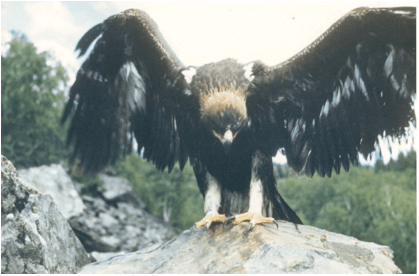
Photo by Walter Spofford
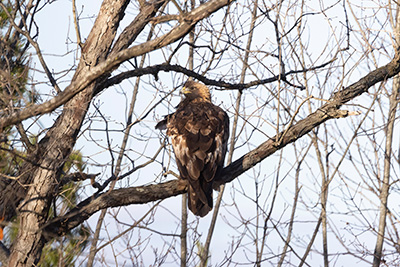
Photo by Mike Lanzone
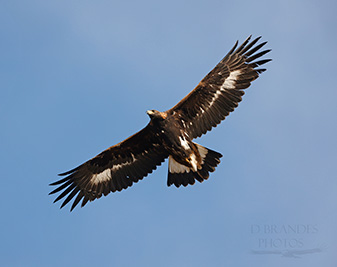
Photo by Dave Brandes
Status
Golden eagles are a conservation priority across North America, with the genetically distinct eastern population currently listed as endangered in Maine. While these birds once nested throughout New England, knowledge gaps persist regarding their current density and distribution in the East. Maine's history with the species is deep-rooted. Traditional Abenaki names and sketches from as early as 1689 document their long-standing presence on the landscape. One historic Maine eyrie, occupied for at least 70 years, is considered among the earliest known nest sites on the continent. However, the population declined steeply in the 20th century; a fledgling has not been observed in the state since 1960, and Maine's last territorial adult disappeared after 1997.
Currently, the only confirmed breeding pairs in eastern North America are in Canada. While golden eagles are rarely seen in Maine during the summer, GPS tracking has shown some individuals return to areas near historical nest sites. Although these specific birds didn't exhibit typical nesting behavior, it is possible that new breeding pairs could be present and go undetected due to their secretive nature and the remote terrain they inhabit. Because breeding groups are active just across the border in Québec, the re-establishment of nesting pairs in Maine remains a distinct possibility.
How you can help:
- Learn more about the ways to participate in the Maine Golden Eagle Study.
- Report Golden Eagle photo observations to eBird, the MAINE Birds Facebook group, or through the Maine Golden Eagle Observation Form.
Threats
Eastern golden eagles face a range of human-caused threats.
Shooting remains a leading source of mortality, even though the species is federally protected. Collisions with vehicles and power lines are another common cause of injury or death.
Exposure to toxicants such as lead and anticoagulant rodenticides remains a concern. Although data are limited for eastern populations, lead poisoning has been documented in eastern golden eagles and may have population-level impacts. Eagles can become exposed to lead by consuming carcasses containing fragments of lead ammunition. Other contaminants, such as mercury and legacy pesticides, may also affect individuals but are poorly understood.
Habitat fragmentation, changing land use, and human disturbance, including recreation and resource development, may reduce habitat suitability or hinder recolonization of historical nesting areas. Climate change could further affect habitat quality, alter the availability and abundance of prey, and influence migration patterns. Other raptor species have been reported to face disease threats, such as avian influenza, which could pose additional risks.
Knowledge gaps remain for the eastern population, and continued research and monitoring are critical to understand the full magnitude of these threats.
Conservation and Management
The MDIFW Raptor Biologist is an active member of the Eastern Golden Eagle Working Group (EGEWG), which identifies, prioritizes, and coordinates collaborative and independent research and management efforts to conserve eastern golden eagles. The group focuses on international, regional, and local conservation to protect the breeding, migratory, and wintering grounds of the golden eagle population in eastern North America. They aim to raise awareness about golden eagles and develop effective conservation strategies.
As part of this commitment, the EGEWG developed a comprehensive conservation plan, outlining objectives for the species (this webpage includes content from the plan). Maine has taken proactive steps by initiating a study aligned with these objectives.
The Maine Golden Eagle Study aims to increase awareness of golden eagles in the state, increase participation in conservation efforts, and address knowledge gaps to inform management actions. There are several ways for birders, hunters, landowners, trappers, and wildlife enthusiasts to participate.
How you can help
- Learn more about the ways to participate in the Maine Golden Eagle Study.
- Hone your bird identification skills and learn the difference between Golden and Bald Eagles.
- Report Golden Eagle photo observations to eBird, the MAINE Birds Facebook group, or through the Maine Golden Eagle Observation Form.
- Share information and learn how choosing lead-free ammunition for hunting benefits eagles by visiting the lead-free ammunition page or viewing the how choosing lead-free ammunition benefits eagles handout (PDF).
- Avoid leaving carcasses harvested with lead ammunition on the landscape, such as in gut piles or as bait.
- Support wildlife conservation in Maine through donations to the Chickadee Tax Check-off, the Loon Conservation Plate, Maine Birder Bands, and special lottery ticket sales (Maine Outdoor Heritage Fund).